
Art and Design: Art, Craft and Design
Course Information
| Literacy |  |
|---|---|
| Numeracy |  |
| Communications |  |
| Creativity | |
| Practical | |
| Group Work |  |
| Examination Assessment | 0% |
| Non Examination Assessment | 100% |
| EBacc | No |
| Examination Board | AQA |
| Course | GCSE |
General Information
Video Transcript
00:00:01
So welcome to the Year 9 Art Options video.
00:00:04
I'm Miss Massey and I'm the Head of Art and I'm going to introduce you to the three different GCSEs that we offer.
00:00:10
First one being Art, Craft and Design, then there's Photography and then there is Textile Design.
00:00:18
So why choose an Art and Design GCSE option?
00:00:21
If you enjoy being creative and you want to increase your practical skills and improve your analytical, communication and research abilities, an Art and Design option is a great choice.
00:00:32
The skills you gain will make it a great complement to other subjects.
00:00:36
Art and Design is a way of seeing things and making sense of the world around you and it can help with further study and prepare you for the world of work.
00:00:43
It's a practical subject.
00:00:45
It is every lesson you are doing practical work.
00:00:48
So if you're a hands-on person who likes to create and make, then any three of our options are really good for you.
00:00:55
Now, we offer these three options because first of all, there's Art, Craft and Design, which is a very broad course.
00:01:01
You can do any type of art or craft within it.
00:01:05
So whether that would be traditional painting and drawing, or whether that would be more 3D work or digital art or printmaking, it's down to you and also down to our first year in year 10, where we'll introduce you to many of those things.
00:01:22
So you're not just stuck with just doing one type of artwork.
00:01:25
You have a choice of many types.
00:01:28
If you already know that you prefer photography or textiles, then brilliant, because you could just study that in a whole course, GCSE Photography or GCSE Textile Design.
00:01:40
So all three courses have the same structure.
00:01:44
They have the same way that they're marked, just the difference is, is the type of practical skills that you're gonna be using within them.
00:01:52
Okay, so time for a bit more information about each three of those courses and what your artwork might look like if you're studying one of those.
00:02:02
So first off, art, craft and design.
00:02:05
So it explores ideas, conveys experiences or responds to a theme or issue of personal significance in your work.
00:02:13
So areas of study are really broad.
00:02:15
And we cover disciplines such as drawing, painting, sculpture, installation, mixed media, photography, graphic design and textiles.
00:02:23
And we introduce you to a little bit of everything at the beginning of Year 10, because some of you might be really keen painters and drawers, but some of you might be able to get your artistic intentions through something more like graphic design or computer-based or printmaking or 3D sculptural stuff.
00:02:40
So we make sure that we do all of those things so that you can get the best out of the
00:02:45
that you want.
00:02:47
You might start the course and think I really love painting but you might end the course thinking oh my goodness printing is so much better for me so that's why we have all of those options there available to you.
00:02:59
Now we work in sketchbooks throughout the projects and the journey of our coursework is done throughout the sketchbook with end outcomes made at the end.
00:03:11
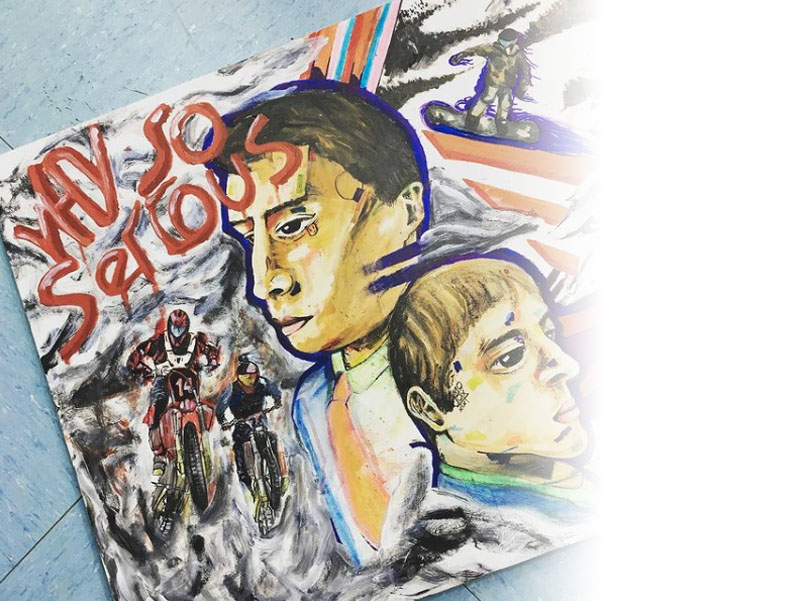
Here's some more examples of outcomes that have been done by students past and present.
00:03:15
So here from traditional painting to more illustrative style to spray painting, lots of things on there.
00:03:26
Photography.
00:03:27
So you produce images using light sensitive materials such as photographic film or digital methods of development and production to create static or moving images.
00:03:39
So areas that we could study include portraiture, installation, photojournalism, and moving image, as well as things like fashion photography too.
00:03:50
So with photography, we make sure in year 10 that you're familiar and you're skilled in learning the digital SLR cameras, so the big cameras, so that you can understand all the different settings involved, such as aperture, how to fix your shutter speeds to do
00:04:08
fast pictures or slow pictures.
00:04:11
We teach you how to use studio lighting to enhance pictures taken inside.
00:04:17
We also teach you the basics in Photoshop and some people
00:04:23
will then try to expand their Photoshop knowledge a bit more.
00:04:26
Some people might go for more analogue ways of working like printing, cutting, sticking images together or traditional documentary style photography as well where it's more about the the story that you're telling in your pictures.
00:04:41
More examples of current work
00:04:48
What I didn't mention as well is that many of our students take pictures on their mobile phones too, and they can be just as good because it's all about learning the decent composition and how to tell a story in your work.
00:05:00
So mobile phones are excellent for independent learning work, homework that you would do.
00:05:07
Textile design.
00:05:09
So your chance to design products for woven, knitted, stitched, printed, or decorative textiles.
00:05:16
So areas of study could include fashion design, illustration, costume design, constructed textiles, printed and dyed textiles, and digital textiles.
00:05:27
So like with the other two courses, beginning of year 10, there'd be a project that would introduce you to skills that you may not already know, such as weaving, printing within fabrics or screen printing, felting,
00:05:44
applique, many stitching construction techniques too.
00:05:50
So once again, sketchbook work to detail out the coursework project and then end outcomes made afterwards.
00:05:57
So here are some more examples done by recent or current students.
00:06:08
What skills will you learn on a course like art, photography or textiles?
00:06:12
So alongside improving your practical expertise, and as I've said they're all practical courses so you'll get a lot of practical expertise from them, you'll also learn how to develop and refine and record your ideas.
00:06:26
So that's the sketchbook process of coming up with ideas,
00:06:31
mind mapping a theme, looking at different artists, textile artists, photographers to inspire you, and then coming up with your own ideas from that.
00:06:42
You will also present personal responses that realise your intentions.
00:06:46
So that's after you've worked through your ideas, you create outcomes.
00:06:50
You might create a finished stitched textile piece, or a set of photos, or a nice big painting
00:07:00
to show the outcome from your project.
00:07:04
You'll improve your creative skills through effective and safe use of media, materials, techniques, processes and technologies and you will successfully use visual language and the formal elements of art which are colour, line, form, shape, tone, texture things that we've learned in Key Stage 3 really but much much more expanded so you will use drawing skills for different needs and purposes on all three of the courses
00:07:28
Now, sometimes, especially with GCSE art, people say, do I need to be able to draw really well?
00:07:34
And what I would say is, it's not that you need to be able to draw really well, you just need to be willing to draw, to try new techniques to improve, because some of you will find that your skills lie more in image construction or mixed media or printmaking, of which the drawing skill is more to map out ideas and plan things.
00:07:56
Some of you will be those traditional kind of like drawing
00:07:58
painters who really really want to perfect perfect their ability to replicate life as they see it through their eyes but there's so many different types of art that it's not a prerequisite that you have to be the most amazing drawer in the first place.
00:08:15
In photography you need to be willing to draw out thumbnail sketches of an ideas and things like that but it could be stickmen or it could be like drawing within
00:08:25
digital drawing within Photoshop, for example.
00:08:29
Personal attributes suitable to art subjects are independence.
00:08:34
Independence because you're going to be planning a lot of your own ideas and you'll have your teacher there to help support that so that it becomes really your work as opposed to something that you're told to do.
00:08:47
So independence is a good part of that, but also that ability to ask for help if you need it, if you don't understand.
00:08:55
Curiosity and the ability to experiment are paramount.
00:08:59
You have to be able to try new things, be prepared to get it wrong sometimes, and then learn from it.
00:09:06
So creative and imaginative thinking, of course, it's a creative subject, so you need to be able to think up different ideas, not be scared of getting things wrong.
00:09:16
All ideas are good ideas.
00:09:18
You have to be really organised, and the reason we say this is because
00:09:22
we have continual coursework deadlines throughout year 10 and 11 because we're 100% coursework assessed.
00:09:30
So you have to be able to keep up with those deadlines and stay on top of the work, make sure that you're using lesson time well, make sure that you're using independent learning time well too.
00:09:42
Right, how is the course assessed?
00:09:44
So
00:09:45
This is what I was saying before.
00:09:47
It's 100% coursework assessed, but it's separated into two slightly different projects.
00:09:54
So first of all, we've got 60% of the mark is the portfolio.
00:09:58
So something that we often refer to as your coursework.
00:10:02
So this is producing a sustained project and a selection of further work that represents the course of study.
00:10:08
So this is completed throughout lessons and independent learning time for the whole of year 10 and autumn term of year 11.
00:10:16
So that's a long amount of time to produce a whole portfolio full of work, showing lots of different skills, looking at different artists, looking at different themes.
00:10:27
Once again, this
00:10:29
Course structure breakdown is the same for all three of our GCSEs.
00:10:34
It's just obviously the portfolio of work for photography would just have photographic work in it, and the textiles one would just have textiles design work in it.
00:10:43
So component two is the externally set assignment, and this is 40% of the mark.
00:10:49
So there's a separately externally set task paper for each title.
00:10:55
So photography gets its own, textiles gets its own, art gets its own.
00:11:01
So it features seven tasks and you only have to complete one of them and you get sketchbook preparation time to do this, which is essentially all lessons between January to April in year 11.
00:11:12
Plus then you have 10 hours of supervised time at the end of April where you would create a final outcome.
00:11:18
Now that 10 hours is not done all in one day.
00:11:21
It's split across a couple of days.
00:11:23
So it's like you finally get a good amount of time to make one big piece of work.
00:11:29
And some of you might be thinking, oh my goodness, 10 hours is ages.
00:11:32
But you'll know that if you really get into creating and making something, 10 hours just flies by and 10 hours,
00:11:40
really show what you are capable of achieving in that amount of time.
00:11:45
But the bulk of your mark, you can see, is actually work completed in lesson time and homework time as well.
00:11:53
So this is why, once again, it's really good to be organised on this course because it's that continual amount of work that you'll be chipping away at, guided by your teachers until you have a whole portfolio ready.
00:12:08
Also just, it's worth noting that the component two externally set assignment, it almost works as a mini project like the ones that we would have done for component one.
00:12:19
So it's like by the time you do it, you'll know exactly how to work out your sketchbook, how to start a project, how to finish the project.
00:12:29
So it's like the whole of the rest of the course is like in preparation for how to do this.
00:12:33
So we like to celebrate our students' work through yearly exhibitions, highlighting their work on social media.
00:12:41
So we understand that the amount of hard work that goes into students' artwork, it's there to be shown off, it's there to be celebrated, which is why the art department is always so full of inspirational work that new GCSE students look to and aspire to have work as great as that.
00:12:59
And this is why you can see from the work, we have a great selection
00:13:03
of outcomes that people, students will do for the work from our big kind of like hanging insulation work to our paintings, to our photography, to our textile work.
00:13:15
So yeah, it's really important to show off the work because you guys work so hard to produce it.
00:13:24
How will this course fit in with other subjects if you choose it?
00:13:28
So studying an Art and Design option helps to create a broad and balanced curriculum for you.
00:13:33
it's an excellent foundation for whatever you want to do afterwards.
00:13:37
So the transferable skills that you gain are creativity, analysis and problem solving and these complement a range of other subjects and careers.
00:13:46
What's also really good about the subject is because of that practical nature of it and because it's not a sit-down exam at the end in a hall remembering facts that you've learnt in class really well
00:14:00
This is something where you, it's almost like you use another part of your mind to do it.
00:14:06
You're continually working on it, you're working with your hands, you're using your imagination, which is why it's a nice kind of like balance to your more, to your core subjects, to your other optional subjects.
00:14:21
So it's doing something very, very practical alongside all of the other things that are much more maybe pen and paper
00:14:30
and preparing for exams.
00:14:34
So, great.
00:14:39
So lastly, art and design opens the doors to lots of exciting careers.
00:14:44
So we all know that studying art and design-based subjects can be fun and rewarding.
00:14:48
They can even help you concentrate better and make you think more creatively.
00:14:52
But can they lead to real jobs and careers?
00:14:55
So the answer is yes, they absolutely can.
00:14:59
So the creative industries are some of the UK's most successful, varied and fastest growing sectors and they provide millions of fulfilling job opportunities.
00:15:07
So I'm just going to reel off some of these in front of you because there are so many and I might just lose all of the ability to speak in a moment.
00:15:16
So we have fashion designer, graphic designer,
00:15:19
theatre designer, animator, video game designer, illustrator, museum curator, photographer, architect, product design, textile design, ceramics, advertising, publishing, interior design, fashion and media journalism, hair and makeup design, retail design, exhibition design, jewellery design, artist, visual media and teaching.
00:15:39
Hooray!
00:15:41
I would recommend looking up the website creativejourneyuk.com for more information from arts-based professionals explaining how their arts education benefited them.
00:15:51
But it's also worth reminding that if you take GCSE Art, you don't have to do any career later on linked with art.
00:15:58
It's just a good subject to have to balance out the other subjects because it's much more practical and it's much more, it's just a different kind of skills that you're learning within the subject.
00:16:11
OK.
00:16:18
I'm Naomi Cleaver, and I'm a designer, writer, and broadcaster.
00:16:23
I know that studying art subjects can be enjoyable and rewarding.
00:16:27
I even think they make you better at other subjects because they help you concentrate and make you think more creatively.
00:16:35
But can studying art and design, or design and technology, really lead to a career?
00:16:41
Some people think that there are very few opportunities.
00:16:45
But today, there are, in fact, 2.8 million creative jobs in the UK.
00:16:51
That's one in 12 jobs.
00:16:54
And some people say, oh, you're too clever to study art or design.
00:16:58
But most of the UK's brightest talents studied these subjects at school and then at university and went on to a successful career in the creative industries.
00:17:08
So what exactly are the creative industries?
00:17:13
The creative industries in the UK are huge, dynamic and varied.
00:17:18
Architecture, advertising and marketing, book and magazine publishing and fashion, and every type of arts and craft design, including game design.
00:17:28
Our museums and galleries, and of course the full range of visual and performing arts, including dance, music and theatre, TV, film and radio.
00:17:39
The creative industries contribute 84 billion pounds to the UK economy every year.
00:17:46
And the sector is large and varied.
00:17:50
I am a software designer.
00:17:52
An architect.
00:17:54
I'm a freelance photographer.
00:17:56
I'm an artist.
00:17:58
Structure lends an image.
00:18:00
I'm a designer, an art director.
00:18:03
Where would we be without all this creative talent?
00:18:07
But what about the UK's next creative generation?
00:18:12
Well, in the last 20 years, the creative industries have grown faster than any other sector and continue to do so.
00:18:20
I want to go into fashion.
00:18:22
I want to be a 3D designer.
00:18:24
I want to be a photographer.
00:18:25
And I want to be an architect.
00:18:27
So if you keep studying art, design and technology at school, this will give you a start on your creative journey.
00:18:34
You could go on to study them at college, university, or even do an apprenticeship.
The course provides opportunities for each pupil to recognise and develop their own creative ability and to appreciate the relevance of Art and Design to everyday life and the wider environment. Pupils will study a wide range of techniques and media that will enable them to specialise in Fine Art, mixed media, printmaking, Photography, Graphics and a range of other specialisms, so that a final portfolio of work can be produced.
What will I need to succeed?
- Be willing to think for yourself.
- Try to show your individuality.
- Be willing to work independently.
- Want to try out different techniques; you do not have to be able to draw perfectly!
- Be willing to work in your own time and take it seriously.
- Persevere and don’t give up. It really is worth it!
Expected Subject Content
During Year 10, all Art & Design pupils will follow a distinct programme of study that is designed to build practical skill, independence and visual literacy. Pupils will undertake a variety of small units of work designed to enable them to build a portfolio of work throughout Years 10 & 11.
Each pupil’s individual skills will be directed and counselled through a variety of projects, examples being work with printed, constructed and applied textile design, sculpture, ceramics, Fine Art, collage and print making.
Some projects will place emphasis purely on visual aesthetics, whilst others will emphasise other important factors, such as the function and suitability of a design for a given purpose or the personal exploration of a given theme. All of our units of work are reviewed regularly and will usually respond to the exam board’s requirements and suggested exam study topics.
All projects will include an element of critical study, and drawing and painting directly from observation, as analytical study will provide many concepts on which to base design for original artwork in two and three-dimensional media. The design process, showing sequential stages through which ideas pass before being finally realised, is considered an important part of the course, as are values of craftsmanship, both in execution and presentation of work.
When pupils show particular strength in art, a craft or design area, they will be encouraged to specialise in this during the examination period.
Please note that pupils cannot study GCSE Photography or GCSE Textile Design alongside this course.
All Art and Design GCSEs are 100% coursework, which means the majority of work undertaken in the classroom, and for homework, from September Year 10 will be submitted for final assessment. The expected weekly homework time for each subject is 1-2 hours.
Expected Assessment Requirements (1-9 Grades)
Examination: 40%
Pupils will receive the question paper in advance, so that preparation can be done thoroughly (8-10 weeks will be allowed for this). 10 hours will be allowed for the actual examination, plus time to prepare materials and present the completed project.
All preliminary written work, designs, drawings etc. will be presented for examination with the completed ‘examination piece’, which is likely to be a painting, textile design, sculpture, screen/lino print, or a piece of ceramics. Each pupil will decide on the type of response they wish to make from the choice of questions/stimuli.
Coursework: 60%
For examination, one extended project is required and any other number of smaller projects in addition. Regardless of the number of units submitted, all assessment objectives must be met in the coursework as a whole. Each will show the development of ideas and research, leading to completed designs and works of art. A definite theme or design brief will be the starting point for each unit and, from this, pupils can produce any quantity of work in a variety of media. Some projects will take one term others may stretch over two, with continuous formative assessment taking place. Sketchbooks are a continuous homework element of the course. Pupils are expected to visit local art galleries and museums and to take a general interest in the whole environment. Trips are often arranged to gallery exhibitions in London and Hampshire to support learning and engagement.
What careers it can lead to after leaving Swanmore College
Advertising
Animator
Architect
Computer Graphics
Fashion Design
Fashion Journalism
Film Director
Illustrator
Interior Designer
Landscape Architect
Cartographer
Packaging Designer
Set Design
Web Designer
Textile Artist/Designer